
The following article is an excerpt from a piece written in the Winnipeg Free Press on August 22, 2025 by Erik Pindera. It highlights some of the work being done by IJC. Click here to read the full article.
It was early in Don Shackel’s career, while working in the mental health and addictions field in northern Ontario, when he met a woman who had given birth to a child with FASD.
That started him on a path that has included work with the Interagency FASD Program in Winnipeg in the 1990s and with northern First Nations as an FASD specialist.
“Connecting the whole issue of fetal alcohol and the justice system, I come at it from a different perspective,” said Shackel, who is now the executive director of Initiatives for Just Communities, a non-profit that provides supports to adults with cognitive disabilities, including many with FASD, in Winnipeg and southern Manitoba. Earlier in his career, he worked as a corrections officer in Brandon.
IJC runs day and residential programming — where some participants live in supported but independent housing or with families — while helping participants gain basic life skills and structure. It also develops circle-of-care plans, where participants learn about their disabilities and develop a path forward in life.
“The majority of people we work with that have (FASD), we support them in an outreach program. So they could have anywhere between five to 30 hours of support a week, where they could live independently or with their family, and we provide help with basic needs,” Shackel said.
Shackel, whose career has largely been spent working with First Nations governments, noted his organization, other non-profits and the provincial government provide programming that isn’t available in Indigenous communities for adults. Much more disability support is available for youths under Jordan’s Principle, the federal government’s legal obligation to ensure First Nations children have access to proper health care, among other supports.
In recent years, IJC has added cultural programming and traditional healing — such as sweat lodges — for those they work with, a significant number of whom are Indigenous or First Nations.
But Shackel hopes to see more services made available in First Nations communities across the province, so adults with FASD don’t have to move south from their homes — where they are already connected to family and their culture — to receive the help they need.
“Those services help keep people out of incarceration,” he said.
People like Russ Hilsher.
Hilsher, now 48, was diagnosed with FASD as an infant shortly after being taken from his Ontario birth mother and placed into child-welfare care. He eventually landed in Winnipeg.

Despite his criminal past — which includes a record for assaults, breaches of court-ordered conditions and theft, and saw him in and out of Manitoba’s jails — he’s given presentations about living with FASD to judges, justice officials, educators and others in Winnipeg and in northern Manitoba First Nations.
He knows first-hand that there are better options for individuals with FASD than cycling through jails.
“I think society really needs to take a look at restorative justice… not be afraid to try things… that’s what I always tell the judges, ‘You can’t be afraid to try things,’” Hilsher said in a recent interview at the IJC office in Winnipeg’s West End.
“They have so much power to send someone’s life in the right direction, or continue them down this path of in and out, in and out of incarceration… that’s what I tell the judges.”
He said he looks at the world differently than people without FASD, and that it takes him a long time to understand certain concepts.
“Let’s just say if this was left here,” he said, gesturing to a reporter’s voice recorder. “When you left and everybody else left, to me, that would tell me you didn’t want that anymore, and no one else seemed to want it, so why would I not take it? I’m not understanding that’s not mine, that it’s still yours.”
Hilsher, who lives in supported housing, is grateful to have been given a diagnosis, which has provided him better understanding of his behaviour.
“If I wasn’t diagnosed in my life, had things set up the way they are, I would be in prison or dead — that’s realistically, (with) no supports in place,” he said. “But because of the diagnosis and the supports I’ve received, that’s been avoided. I’ve been very fortunate.”
Hilsher’s longtime direct support worker, Harri Vallittu, said the difference in Hilsher from the early days working with him “is incredible.”
Vallittu thinks the justice system is beginning to better understand the issue.
“There seems to be a willingness now, it’s starting, that we’ve got to look at this problem with a different set of glasses here, zero in on it a bit more — why is it happening and what can we do to improve it? There have been some improvements,” he said.
“Every case is different, right… and just because you’ve done a crime and have FAS, you’re still responsible for it, but the punishment should be looked at differently. And it seems that it’s starting.”
Shackel turns off Highway 12 near Steinbach and heads down a series of gravel roads before turning his pickup truck onto a narrow driveway.
He gets out and, with sweat beading on a muggy July day, points to an eagle circling above where a fire burns in preparation for a sweat lodge.
Shackel is at El’dad Ranch, a program run by IJC where men with cognitive disabilities, including many with FASD, learn life and work skills, such as cooking and cleaning, and receive vocational training in areas such as cutting wood, basic carpentry and automotive mechanics.
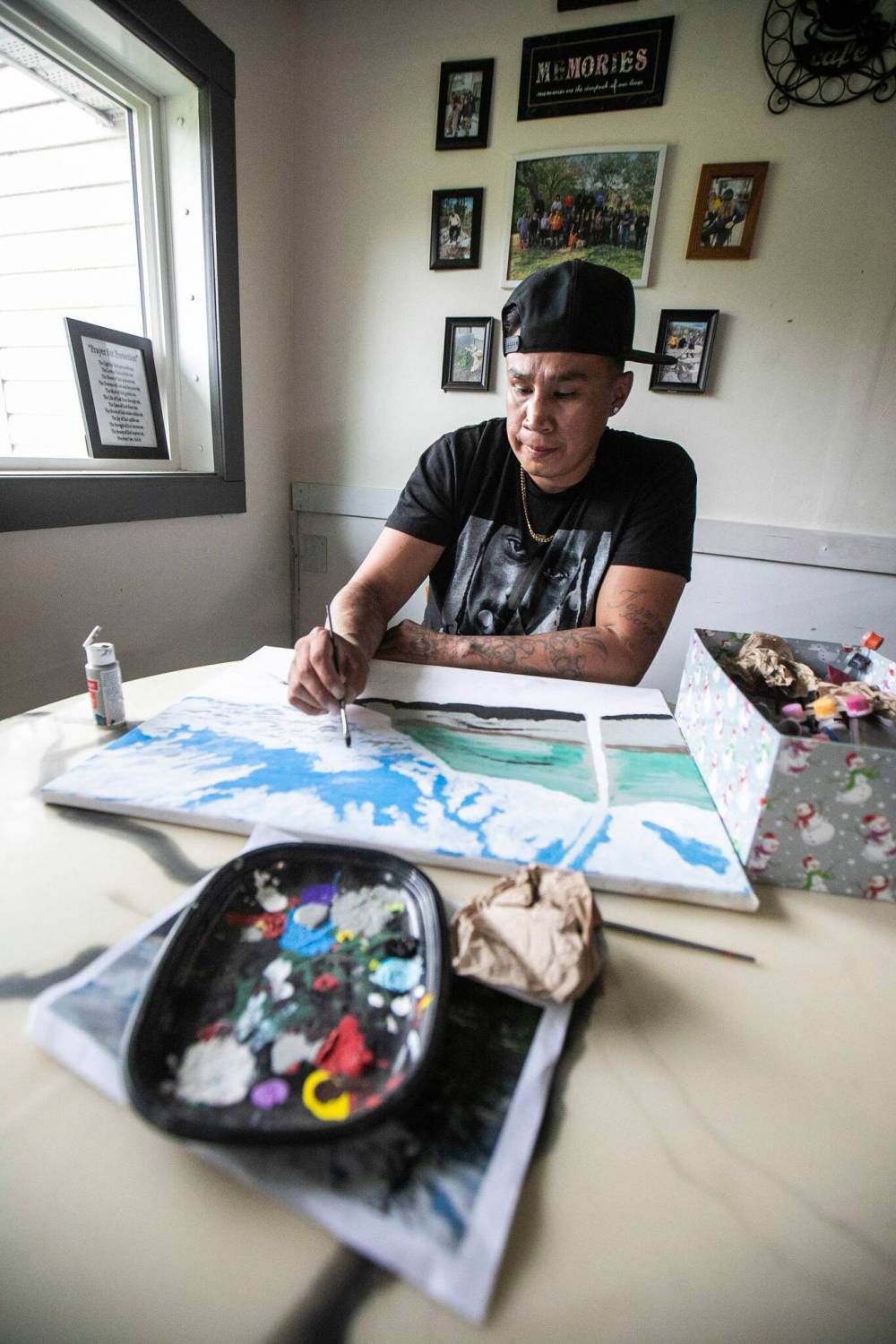
Some of the men live at the ranch as part of the non-profit’s alternative justice program, either while on bail awaiting court proceedings, on probation or as a conditional sentence — essentially house arrest — instead of jail or prison, while others attend the ranch for day programming.
Meeko McDonald, a 37-year-old with FASD currently on probation for two counts of assault with a weapon, has been at the ranch for two years as part of the justice program.
While learning how to plan for life away from the ranch, he’s also begun to paint, draw and take part in cultural programming, and is working on his life skills. He’s hopeful he can break the cycle of re-offending.
“Every time I went to jail, I always told everybody I’m not coming back, then all of a sudden I come back. I guess the guys, even all the guards, are like, ‘I knew you were coming back’ …,” he said.
“It’s better. I like it here, more than Winnipeg anyways. When I (return) to Winnipeg, I want to come back a better person.”

Kailey Schultz has been the ranch’s alternative justice program’s co-ordinator for eight years, though she has spent time at El’dad since she was a child, when her father, Randy Schultz, helped set up the program.
“It’s a place to serve their jail time, or sentence, in a more meaningful way than what jail can offer them. Often, people with FASD can struggle to understand consequences and we’re able to provide wraparound case-management services in a place where they can learn and grow in a safe environment,” she said.
There is no question the approach works, she said.
“Even if there is a relapse, per se, into the justice system, I feel like we’ve been able to provide them skills that can still benefit them in a way, or reduce the harm later on in life, whether it’s to the community or to themselves, if they do end up going back,” she said.
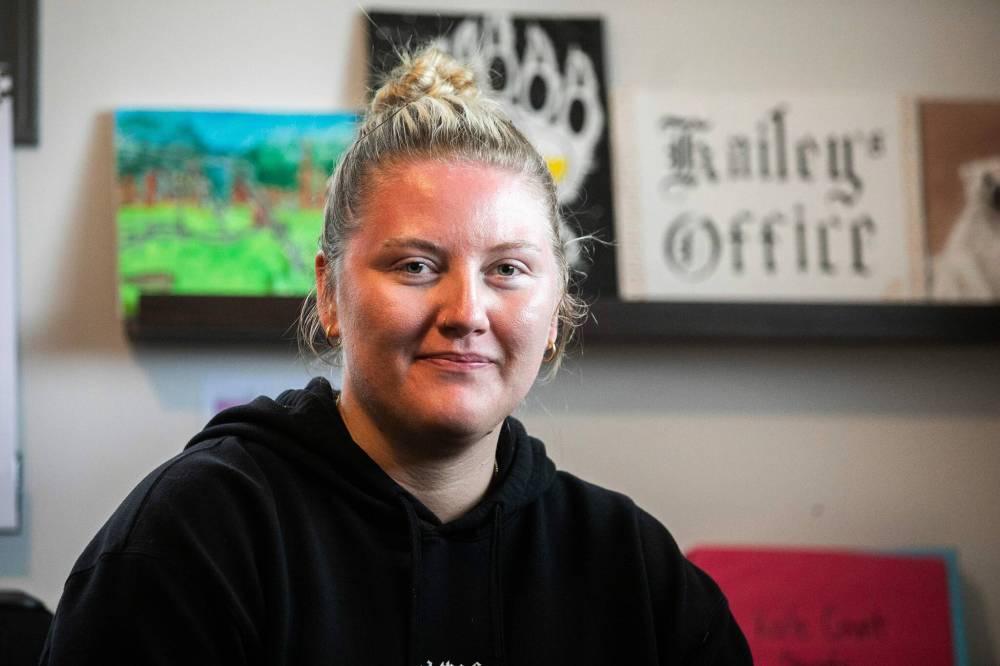
“We have seen some individuals that do not go back into the justice system … A lot of people give up on people in this demographic, with legal challenges, like there is no hope. But there is, and we cannot give up on people, never.”
In addition to working on practical and vocational skills, the men learn about boundaries, emotional regulation, mental health and how to address their addictions, in a stable and consistent environment.
“A lot of them didn’t have that growing up, to have stable environments. To be able to have, no matter what challenge comes up, we have a support for them — there’s someone there, we can support them through that, whether it’s the justice system or getting their kids back from CFS, or financial challenges, or budgeting,” she said.
“I think that’s how people with FASD can flourish, that wraparound case-management service.”